Blog
How do you check whether AI recommends your business?
In short: You check AI visibility on three levels: whether AI mentions your business at all, whether it describes it accurately, and whether it brings in inquiries. One test in ChatGPT tells you nothing, because answers change with every try. You need a fixed list of customer questions you check regularly, the AI report in Google Search Console, and one question for every new customer: how did you find us?
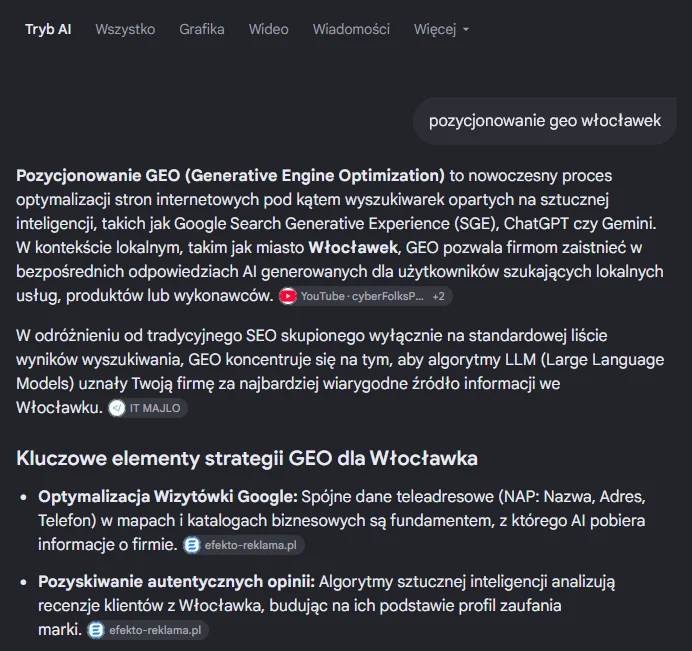
I typed “pozycjonowanie geo włocławek” (GEO services in Włocławek, the Polish town I work from) into Google's AI Mode. The answer cites efekto-reklama.pl twice: on Google Business Profile and on customer reviews. You can't buy that spot like an ad. AI has to decide your site is a good source.
One screenshot isn't measurement, though. Clients ask me: “how do I know whether it's working for me?”. Below I show how I check it, using real charts from a client. This post expands on point 10 of 10 things you need to know about AI search if you run a business.
What should you measure to know whether GEO works?
You measure three things: whether AI talks about your business, what it says about it, and whether any of that leads to sales. The first one alone isn't enough, because you can be visible and still not get calls.
| What you check | Question | How to measure it |
|---|---|---|
| Presence | Does AI mention your business? | In how many answers to customer questions your name comes up, whether you're recommended and whether there's a link to your site |
| Description | Does it tell the truth about you? | Whether your services, city, hours and prices are right, and which pages AI takes this from |
| Impact | Do customers come from it? | Visits from AI in your analytics, calls and form submissions, the customer's answer to how they found you |
The first row covers three different things worth telling apart:
- mention - AI names your business
- recommendation - AI suggests your business as one of the options
- citation - AI links to your website as a source, like in the screenshot above
A recommendation matters most when the question comes from someone ready to buy, like “who wraps company vans in my city?”. A mention in a general question such as “what is GEO?” builds awareness, but rarely ends with a phone call.
How do you build a question list for testing?
A question list is a set of questions your customers actually ask, written down once and checked the same way every time. To start, 10-20 questions in four groups are enough:
- problem questions, e.g. “can a vinyl wrap be removed without damaging the paint?”
- cost and choice questions, e.g. “how much does it cost to wrap a company van?”
- provider questions, e.g. “who wraps company vans in my city?”
- questions about your business, e.g. “what do you know about [business name]?”
Take the questions from calls, emails and reviews, not from your head. And don't pick only the ones where you already show up. The report will look great and tell you nothing.
Why does one test in ChatGPT tell you nothing?
One test tells you nothing because AI can answer differently every time: different wording, a different time of day, a different chat history, and different businesses and sources show up. Ronald Sielinski tested this in a 2026 study. Over nine days he repeated the same questions in Perplexity, ChatGPT search and Gemini. His conclusion: a single run gives a misleadingly precise picture, and many differences between websites fall within normal measurement noise.
For clients, I do this at scale. I ask the same questions to many models, many times, in clean sessions with no chat history or context. I built my own system for it. Then I lay the results over data from Google Search Console and Google Analytics. That shows when, and for which queries, models started citing a site.
You can run a simpler version yourself:
- Write your question list in a spreadsheet and don't change it for a quarter.
- Ask each question several times, always in a new chat or an incognito window.
- Repeat the test every week or every two weeks.
- Record the result as “showed up in 4 of 10 runs”, not “I'm in ChatGPT”.
- Note who AI recommends instead of you and what it gets wrong about your business.
What does the AI report in Google Search Console show?
The generative AI report in Google Search Console shows how many times your site appeared in AI Overviews and AI Mode on Google. Google added it in June 2026, and since the end of August it's available for all websites.
You'll find it in the Performance report, in a box under the chart that links to the generative AI features report. It shows impressions broken down by page, country, device and date. It doesn't show clicks or queries. The same data is also included in the regular Performance report, so you can't see AI traffic on its own there.
This report only covers Google. ChatGPT and Perplexity aren't in it. If Copilot matters to you, Bing Webmaster Tools has a similar report: since February 2026, in public preview, it shows how often your pages were cited in Copilot and in Bing's AI summaries and which phrases AI used to find them. No clicks there either.
What did measurement show for my client?
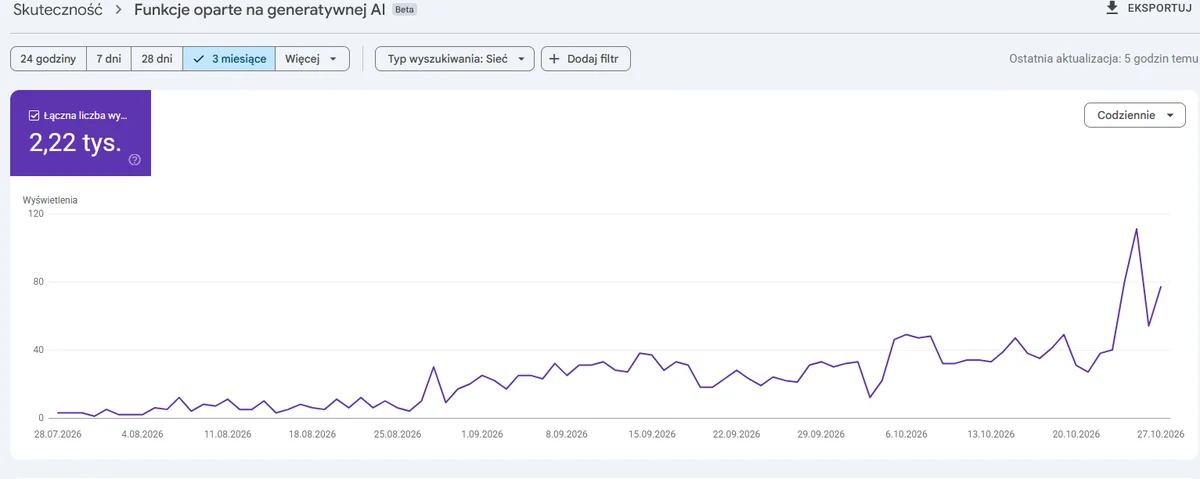
For a client I've worked with for two months, impressions in Google's AI features grew from a few a day to several dozen, peaking above 100 a day. The chart covers three months, so it also shows the month before we started. In total that's about 2,200 impressions in AI answers.
We focused on content: better articles, improved semantics, content structured for AI and structured data. I describe how I do it in how to write website copy that AI will cite.
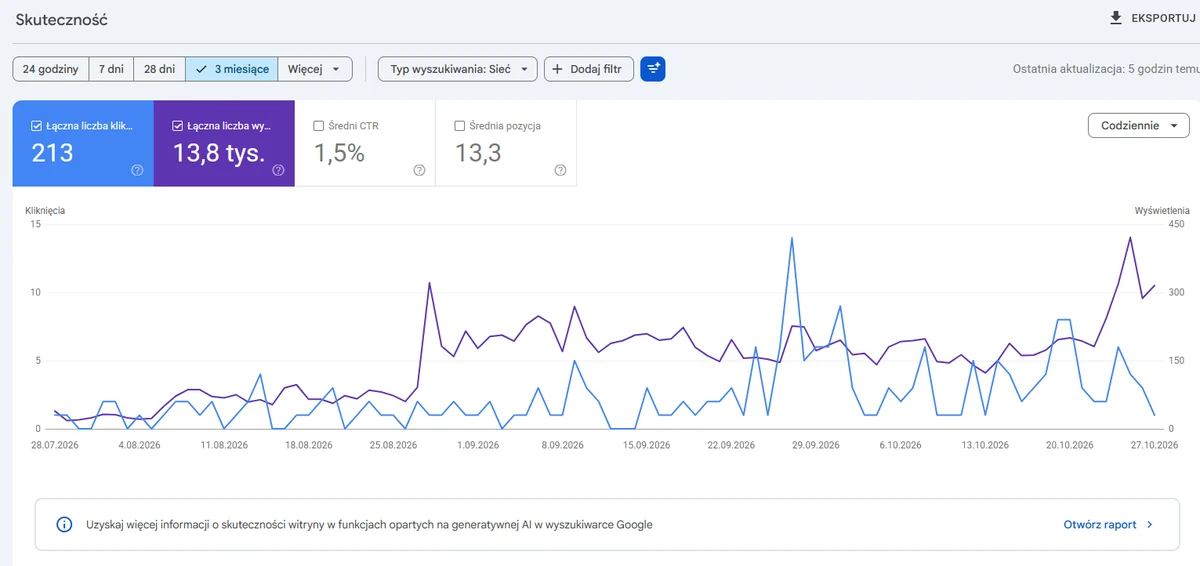
The regular Performance report shows the other side of the story. Google impressions grew several times over, while clicks stayed low: 213 in three months against about 13,800 impressions. Even so, the client started getting inquiries from new customers. If we'd looked only at clicks, we'd have concluded nothing was happening.
How do you check whether customers come from AI?
The most reliable way is to ask customers how they found you and where they decided to buy. Analytics helps, but isn't enough on its own.
Visits from chatgpt.com, perplexity.ai or gemini.google.com show up in your analytics as a traffic source, for example in Google Analytics 4. Simpler tools like Umami show it clearly too. In my next post I'll compare tools for measuring visibility in AI and on Google.
Analytics still undercounts AI's influence, because many people read the answer and don't click. Pew Research Center looked at how 900 US adults browsed in March 2025. When Google showed an AI summary, people clicked a regular result in 8% of cases, compared with 15% without one. They clicked a link inside the summary in 1% of cases.
Second: every analytics system wants to take credit for the customer. Ads, Google, social media - each tool will show it was thanks to them. Ask the customer directly and you often hear something completely different. That's why I ask every new client how they found me, and more and more say AI recommended me.
In services this works more slowly, because a customer has to trust you before buying. In online stores it shows up faster. I saw it in my own store: after implementing GEO, impressions grew a lot, clicks only a little, but the people who came were ready to buy.
What you can do right away:
- add a “how did you hear about us?” field to your form
- ask on the first call and write down the answer
- check in Search Console whether searches for your business name are growing, because some people read about you in AI and only then type your name into Google
What shouldn't you take as proof that GEO works?
Don't take single observations or numbers you can't verify as proof. In particular:
- one screenshot - including mine above. It shows it's possible, but it's not a stable result
- a “GEO score” from a tool that you can't break down into specific questions and answers
- AI bot visits to your site - a bot that read your page doesn't have to recommend it
- citations for questions your customer will never ask
- clicks alone - the client example above shows inquiries can grow faster than traffic
What does simple measurement look like in the first 3 months?
The first three months are about setting a baseline, improving pages and checking whether anything moved.
| When | What you do | What you record |
|---|---|---|
| Weeks 1-2 | List questions and competitors, run the first measurement | In how many runs you appear and who's recommended instead of you |
| Months 1-2 | Improve pages that answer these questions but aren't cited by AI | Whether citations appear for those questions |
| Month 3 | Compare results with Search Console, analytics and customer conversations | What to keep, what to fix, what to drop |
Your spreadsheet only needs these columns: date, question, AI tool, whether your business is there, whether there's a link to your site, what AI got wrong and who's recommended instead of you.
When should you hand measurement to someone who does it every day?
It's worth it when you want to know not only whether you're in AI, but also why and what to do about it. I measure AI visibility in every service: in the free audit and as part of SEO and GEO. I combine results from AI models with Search Console and Google Analytics data, so you can see which changes on your site made a difference.
Frequently asked questions
Can I check whether ChatGPT recommends my business?
Yes. Ask ChatGPT the questions your customers ask, in a new chat, several times and on different days, and record whether your business shows up. One try isn't enough, because answers change with every question.
Does Google Search Console show traffic from ChatGPT?
No. Search Console only covers Google, including impressions in AI Overviews and AI Mode. Visits from ChatGPT, Perplexity or Gemini show up in your site analytics, for example in Google Analytics 4, as a traffic source.
Why do I get more impressions but not more clicks?
Because some people get the answer right away in Google or in a chat and don't click any link. What matters then is whether your business appears in that answer and whether inquiries come in, not the number of visits alone.
How often should I check AI visibility?
Check your key questions every week or two, with a summary once a month. Don't keep changing the question list, or you'll have nothing to compare your results with.
Do AI bot visits to my site mean AI recommends me?
No. A bot may have read your page, but that doesn't mean a model will cite or recommend it. Look at AI answers and customer inquiries, not server logs.